
How Much Does It Cost to Install an EV Charger in Hamilton?
EV Chargers Hamilton, operated by 2E Electrical
Published 28 September 2026Last updated 14 October 2026
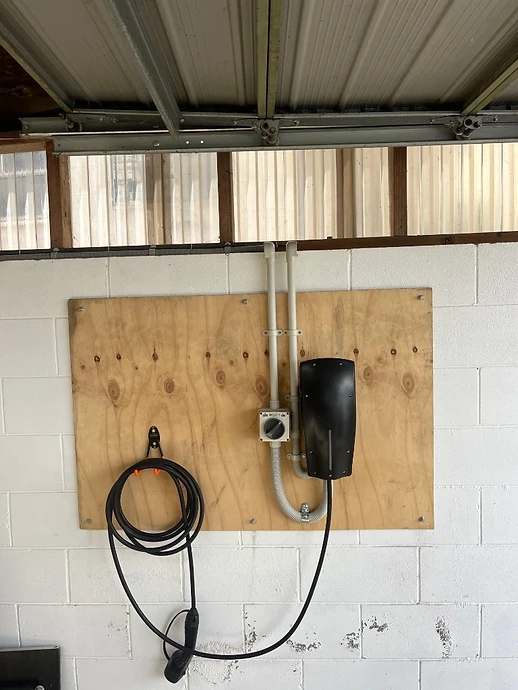
How much does an EV charger cost to install?
There are two parts to the cost of home EV charging: the charger itself and the electrical work to install it.
According to the Energy Efficiency and Conservation Authority (EECA), a smart wall charger typically costs $1,000–$1,500 to buy, while installation typically costs around $500–$1,000, though EECA notes this may increase depending on the charger's location or whether your home's wiring needs upgrading.
Every property is different, so we don't advertise a fixed installation price. 2E Electrical assesses your switchboard, cabling route and protection requirements first, then gives you a firm, site-specific quote.
Breaking the cost into its parts
Charger hardware. Smart wall chargers typically retail for $1,000–$1,500 (EECA). Pricing varies between models depending on their features, power rating and manufacturer.
Electrical installation. EECA puts a standard installation at around $500–$1,000. This covers a licensed electrical worker mounting the charger, running a dedicated circuit back to your switchboard, providing circuit protection, testing the installation and issuing the required certification. The figure assumes a straightforward setup.
Charger + installation packages. Many charger suppliers and installers quote hardware and installation together. These bundles are convenient, but check exactly what's included. Some assume an ideal cable run and add costs for anything beyond it.
Additional electrical work. EECA's figures exclude work some properties need: switchboard upgrades, long cable runs or trenching, extra protection hardware, load management setup or solar integration. These are quoted after a site assessment, so you know the full picture up front.
What affects your quote
- Cable run distance: the further your parking spot is from the switchboard, the more cabling and labour is involved.
- Switchboard capacity: if your board is full or dated, an upgrade may be needed before a charger can be safely connected.
- Smart features and load management: load management lets the charger scale back when the rest of the house is drawing heavily, which can sometimes avoid a more costly supply upgrade.
- Solar integration: linking a charger to an existing solar system may need extra configuration so the car uses your own generation first.
Who can legally install a charger
A wall charger connects to your home's fixed wiring, so the installation is prescribed electrical work. It must be carried out by a licensed electrical worker, who must test the completed installation and issue you a Certificate of Compliance (CoC). Keep the CoC safe. It records that the fixed wiring work has been completed and tested in accordance with New Zealand electrical safety requirements. It may also be useful for insurance claims or when selling your home.
The protection an EV circuit needs
An EV charging circuit has to be safe against two kinds of leakage: alternating current (AC) and direct current (DC). WorkSafe New Zealand's EV charging safety guidelines require the charging supply to protect against electric shock, remain safe if AC or DC leakage occurs, and monitor the earth connection to the vehicle throughout charging.
In a typical home installation this means a dedicated, RCD-protected circuit, plus DC leakage protection, either a Type B RCD at the switchboard or an RDC-DD built into the charger working together with a suitable Type A RCD. A charger that includes an RDC-DD is a good sign, but it doesn't by itself make an installation compliant: the whole installation has to meet the AS/NZS 3000 wiring rules and the charger manufacturer's instructions. This is one of the things we confirm during a site assessment.
Commercial and fleet charging
Commercial installations vary too widely to publish meaningful price ranges. The number of chargers, your site's supply capacity, civil works, load management and, for larger sites, network connection upgrades all shift the total significantly. If you're planning workplace or fleet charging in Hamilton or the wider Waikato, we start with a site assessment and provide a detailed, itemised quote, with the electrical infrastructure designed so extra chargers can be added later without rework.
Why start with a site assessment?
Because there's no reliable one-size-fits-all price for EV charger installation, the assessment is what turns ballpark figures into a firm quote. We check your switchboard capacity, find the most efficient cable route, confirm the protection your installation requires, and make sure the hardware suits your vehicle and your energy setup, whether or not you have solar. Then you receive one clear, fixed quote with nothing hidden.
Frequently Asked Questions
EECA advises that installing an EV smart charger typically costs around $500–$1,000, on top of the charger itself (typically $1,000–$1,500). Costs can increase with difficult charger locations or wiring upgrades. A site-specific quote confirms your actual price.
Not always. A professional assessment will determine whether your current switchboard has the capacity for an EV charger. If it is full or outdated, an upgrade may be required for safety and compliance.
No. A wall charger connects to your home's fixed wiring, so the work must be done by a licensed electrical worker, who will test the installation and issue a Certificate of Compliance (CoC).
Most straightforward home installations are completed within a day, provided the cabling route is simple and no major switchboard work is needed.
Yes. Basic chargers cost less, while smart chargers with Wi-Fi, solar integration and load management carry higher hardware prices, and load management can sometimes avoid a more expensive supply upgrade.
Sources & References
- https://www.eeca.govt.nz/for-homes/vehicles/smart-ev-chargers/
- https://www.worksafe.govt.nz/dmsdocument/72327-addendum-to-electric-vehicle-charging-safety-guidelines-3rd-edition/latest/
- https://www.worksafe.govt.nz/managing-health-and-safety/consumers/safe-living-with-electricity/getting-electrical-work-done/